Draw-and-Guess Prompts for Adult Groups
Pick a prompt, sketch it so others can guess, and keep the round easy with short turns, clear passes, and no requirement to draw well.
3–12 adults; use teams or one shared circle · 10–25 minutes; 45–90 seconds per sketch
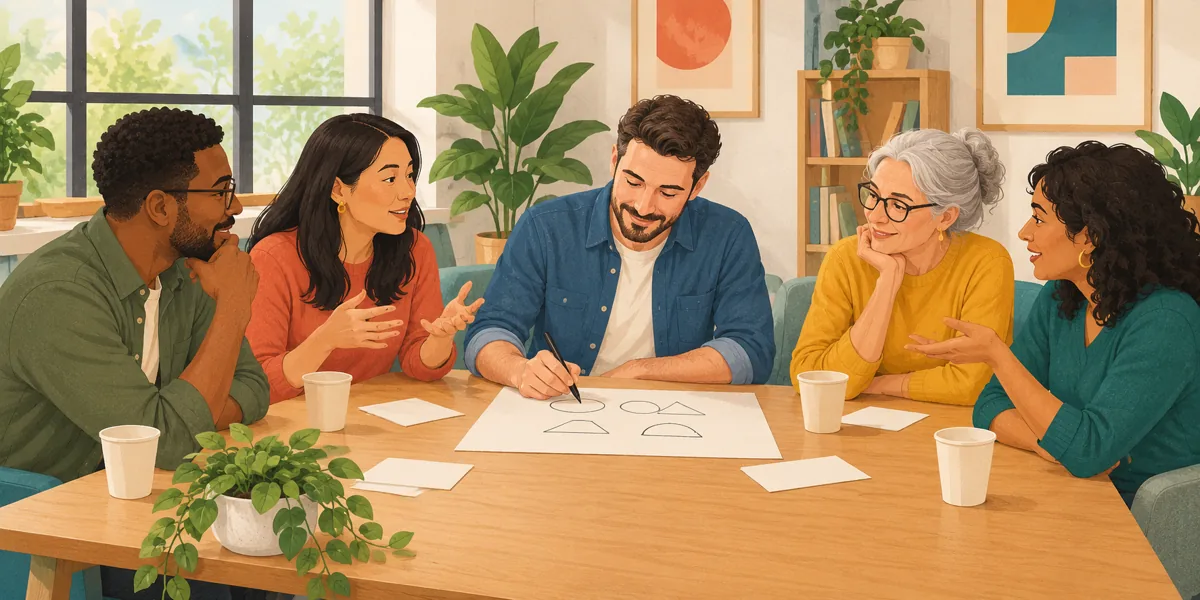
Draw-and-guess works with a pencil, a few simple prompts, and a group willing to interpret rough sketches. This adult-first set offers 50 original objects, scenes, and actions without relying on movie titles, famous characters, or branded game materials. The goal is a shared guessing round, not artistic accuracy. Players can draw, guess, host, type, or observe, and anyone can pass a prompt.
Take it to paper
Host guide, cards and any answer key. Print single-sided, 100% scale, matching the selected paper size.
What you need
- Per group: scrap paper or a small whiteboard and a dark marker.
- One set of prompt cards or a host who can privately show the clue.
- Optional timer; for remote play, use a blank shared canvas or chat guesses.
How to play
- Choose a prompt at random. The drawer reads it privately and may exchange it without explanation. Do not show the clue to guessers.
- Explain the basic drawing rules: sketch the object, place, or action; do not write letters or numbers, spell with symbols, or say the answer aloud. Use simple lines and shapes.
- Start a suggested 60-second round. Guessers may call out answers or type them in chat. The drawer may add details but should not feel pressured to produce a polished picture.
- When the group guesses or time ends, reveal the prompt and move to another volunteer. A pass is always allowed; no one has to draw in front of the room.
- Use a team format if people want a shared target, or let a single circle guess together. Avoid individual rankings; if keeping score, record team points only and skip scoring when it adds pressure.
- Stop after several rounds, ask whether the group wants another category, and move on when ready. Do not treat correct guesses or drawing speed as evidence of skill.
Set a simple drawing rule
Tell the drawer that the clue can be shown with objects, shapes, positions, or a sequence. The default round avoids written words and numbers so guessers respond to the sketch. The host can allow a simple category label for beginners, but decide before the turn begins.
Some prompts are scenes rather than single objects. A quick sketch can use a few anchors: a horizon, a doorway, a person-sized stick figure, or two objects in relation. A rough picture is enough. If the clue is difficult, reveal it and continue rather than extending the turn indefinitely.
Keep the game accessible
Offer seated drawing and large paper. A participant who does not want to draw can choose the prompt, call time, guess, or host the next round. For people who find drawing difficult, use a digital whiteboard with shape tools or let the person arrange prepared shapes. A verbal description alternative changes the game but can preserve participation.
In remote meetings, the host can send the prompt privately to a volunteer. The artist may use paper and point a camera at the sketch only if comfortable; otherwise use a blank shared canvas or let the host redraw from the person’s directions. Cameras and room views stay optional.
Choose a format for the room
For a small group, one shared circle keeps setup simple. For a larger group, divide into teams of four to six and rotate drawers. Explain how guesses work before starting so people do not talk over a quiet participant. A typed-chat option can slow a fast room and make remote play easier to follow.
Choose cards from Object Scene, Place Scene, Action Scene, or Imaginary Object. These labels help the host pick a comfortable prompt without revealing the answer. The set includes familiar and whimsical subjects, but none depends on a specific movie, celebrity, or product.
Printable host sheet
Read: “The drawer sees one private prompt and sketches it. No words, letters, or numbers in the default round. Guess out loud or in chat. You can draw, guess, host, or pass. A rough sketch is enough.” Set a 60-second suggestion and allow a volunteer to exchange a prompt.
Reveal the clue after a guess or when time ends. Switch the drawer, not the person’s score. At the end, thank participants and move on without interpreting their drawings.
Use the 50 prompt cards
The prompt bank mixes single objects, locations, and small actions. A host can print one card per slip, keep the clue side hidden, and let a drawer draw at random. If a clue feels unfamiliar or uncomfortable, swap it for another card.
For an easy variation, remove the timer and let guessers ask one neutral question about the sketch. For a harder variation, let the drawer choose only three shapes or lines. Keep both variations optional and do not use them to compare individuals.
Draw a card
Read the guide first. Draw without repeats; answers stay hidden until you reveal them.
All cards and prompts
For games with secrets, keep this page with the host.
- N_DRAW_GUESS-001
A rolling suitcase beside a crooked direction sign
- N_DRAW_GUESS-002
A half-open umbrella hanging from a wall hook
- N_DRAW_GUESS-003
Three mismatched mugs stacked on a narrow shelf
- N_DRAW_GUESS-004
A lighthouse beside a winding footpath
- N_DRAW_GUESS-005
A paper airplane landing in an open box
- N_DRAW_GUESS-006
A bowl of oranges next to a folded map
- N_DRAW_GUESS-007
A train platform with two clocks showing different times
- N_DRAW_GUESS-008
A rain boot beside a puddle shaped like a star
- N_DRAW_GUESS-009
A tiny garden growing inside a teacup
- N_DRAW_GUESS-010
A bicycle leaning against a very tall fence
- N_DRAW_GUESS-011
A chair under a lamp with a book on its seat
- N_DRAW_GUESS-012
A suitcase with too many luggage tags
- N_DRAW_GUESS-013
A bridge crossing a narrow river
- N_DRAW_GUESS-014
A coffee cup balanced on a stack of notebooks
- N_DRAW_GUESS-015
A folded paper boat floating beside a dock
- N_DRAW_GUESS-016
A market stall with striped fabric overhead
- N_DRAW_GUESS-017
A key hanging from a balloon
- N_DRAW_GUESS-018
A row of shoes outside a meeting room
- N_DRAW_GUESS-019
A plant reaching toward a sunny window
- N_DRAW_GUESS-020
A bench facing a hill with a winding path
- N_DRAW_GUESS-021
A clock with hands pointing in opposite directions
- N_DRAW_GUESS-022
A teapot pouring into a cup that is too small
- N_DRAW_GUESS-023
A map with one dotted route and three landmarks
- N_DRAW_GUESS-024
A person trying to carry a tall stack of books
- N_DRAW_GUESS-025
A suitcase rolling down a gentle ramp
- N_DRAW_GUESS-026
A tiny sailboat made from a leaf
- N_DRAW_GUESS-027
A ladder leaning against a cloud
- N_DRAW_GUESS-028
A long scarf caught on a bicycle handlebar
- N_DRAW_GUESS-029
A window with a flowerpot and two birds
- N_DRAW_GUESS-030
A stack of pancakes shaped like a staircase
- N_DRAW_GUESS-031
A door with three different handles
- N_DRAW_GUESS-032
A bus stop with a bench and a large clock
- N_DRAW_GUESS-033
A picnic blanket with a chessboard and fruit
- N_DRAW_GUESS-034
A paper lantern reflected in a puddle
- N_DRAW_GUESS-035
A small shop with a striped awning and a round window
- N_DRAW_GUESS-036
A person untangling a garden hose around a flowerpot
- N_DRAW_GUESS-037
A rowboat tied beside a pier at sunset
- N_DRAW_GUESS-038
A bookshelf with one book leaning the opposite way
- N_DRAW_GUESS-039
A set of stairs ending at a closed gate
- N_DRAW_GUESS-040
A snow globe containing a tiny lighthouse
- N_DRAW_GUESS-041
A compass beside a folded paper map
- N_DRAW_GUESS-042
A hand holding a kite string with a looping tail
- N_DRAW_GUESS-043
A teacup next to a saucer shaped like a leaf
- N_DRAW_GUESS-044
A suitcase open with neatly rolled clothes inside
- N_DRAW_GUESS-045
A street corner with a bakery sign and crossing signal
- N_DRAW_GUESS-046
A tall stack of empty boxes beside a hand truck
- N_DRAW_GUESS-047
A person planting a row of herbs in small pots
- N_DRAW_GUESS-048
A bridge made of books across a narrow gap
- N_DRAW_GUESS-049
A chair with a small table tucked underneath
- N_DRAW_GUESS-050
A crescent moon over a row of rooftops
Hosting questions
Do people need to be good at drawing?
No. The round is about making a guessable sketch, not producing polished art. A participant may also host, guess, or pass.
Can we use letters or numbers?
The default rule avoids words, letters, and numbers. A host can allow a category label for a beginner round if that is agreed before the turn.
How long should a drawing turn last?
About 60 seconds is a useful starting point. Shorten or extend it by group preference; do not make speed a personal score.
Can we play over video?
Yes. Use a blank shared canvas, chat guesses, or an opt-in camera view of a sketch. Cameras and room views should remain optional.
Try another activity
Original AI-assisted material with AI editorial review. Independent human review, group playtesting and physical printing remain pending. Editorial notes.