Home / Question games / Language Exchange Conversation Questions for Adults
Free adult activities / Always okay to pass
Language Exchange Conversation Questions for Adults.
These 24 short prompts are for adult language exchange partners. Begin with a few words, explain an ordinary object, or invent a tiny scene. Agree which language you want to use; this is conversation practice without a score or proficiency assessment.
2–8 adultsOne card or a short shared round24 original prompts3 question groups
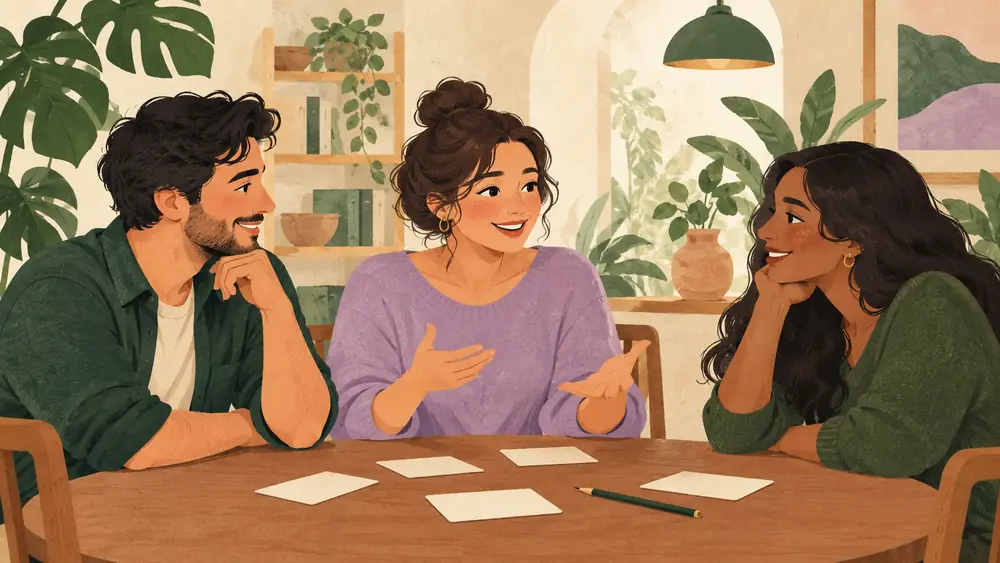
An original scene illustration. The playable prompts and instructions are below.
Small English prompts. Several ways to reply. Choose one prompt to begin; there is no need to finish the deck.
Name something small that belongs on a picnic blanket.
Read all questions below or print the complete deck. Enable JavaScript for shuffled rounds and question-group selection.
This page has no answer field and does not collect replies. Other call or chat services have their own privacy settings.
A little structure, plenty of room
How to use these questions.
These 24 short prompts are for adult language exchange partners. Begin with a few words, explain an ordinary object, or invent a tiny scene. Agree which language you want to use; this is conversation practice without a score or proficiency assessment.
Agree on a language and whether corrections are wanted before choosing a card. Keep joining, listening, and passing optional.
Offer time to think. A word, phrase, paraphrase, or a sketch on your own paper can be enough; nobody has to imitate an accent or answer quickly.
Ask before correcting or adding vocabulary. Close after the agreed number of cards without ranking fluency or collecting answers.
One shared opening · 3–5 minutes
Offer one card, allow thinking time, and invite volunteers. Finish at the agreed point; suggested times have not been tested with groups.
A pair exchange · 5–10 minutes
Read one card, give both people thinking time, and invite a reply from either person. Ask before offering a correction or suggested phrase.
Suggested times are host plans, not results measured with groups. No one needs to finish the deck.
Choose a way to join.
Agree on a format before starting. A quiet pause or an early finish is always available.
A shared invitation
One card, optional replies
Agree on a language and whether corrections are wanted before choosing a card. Keep joining, listening, and passing optional.
Offer time to think. A word, phrase, paraphrase, or a sketch on your own paper can be enough; nobody has to imitate an accent or answer quickly.
A pair exchange
Adapt or stop at the agreed point
Read one card, give both people thinking time, and invite a reply from either person. Ask before offering a correction or suggested phrase.
Ask before correcting or adding vocabulary. Close after the agreed number of cards without ranking fluency or collecting answers.
A short host checklist.
Explain how the activity ends before it starts.
Keep listening, passing, and quiet thinking available.
Do not collect, rank, photograph, or publish answers.
Choose the questions that fit
24 prompts. Choose a group.
The online player can mix all groups or draw from just one. These are the same prompts you’ll find in both PDFs.
Short answers welcome
8 prompts · Cards F32-001–F32-008
Name something small that belongs on a picnic blanket.F32-001 · REV 2026-10-18.1
What can you do with a paper cup besides drinking?F32-002 · REV 2026-10-18.1
Describe a pleasant afternoon in three simple words.F32-003 · REV 2026-10-18.1
Name something round and explain one use for it.F32-004 · REV 2026-10-18.1
What would you put beside an imaginary park bench?F32-005 · REV 2026-10-18.1
Describe a quiet place without naming a real location.F32-006 · REV 2026-10-18.1
What could a shopkeeper say when a shelf is empty?F32-007 · REV 2026-10-18.1
Name an everyday object and say where it might belong.F32-008 · REV 2026-10-18.1
Describe and explain
8 prompts · Cards F32-009–F32-016
Explain how to fold a napkin without demonstrating it.F32-009 · REV 2026-10-18.1
Describe a spoon without using its name.F32-010 · REV 2026-10-18.1
Explain the difference between a shelf and a drawer.F32-011 · REV 2026-10-18.1
Describe an umbrella to someone who has never seen one.F32-012 · REV 2026-10-18.1
Give simple directions across an imaginary square room.F32-013 · REV 2026-10-18.1
Explain what a bookmark does in one sentence.F32-014 · REV 2026-10-18.1
Describe a kettle without making its sound.F32-015 · REV 2026-10-18.1
Explain how a paper boat might move across a pond.F32-016 · REV 2026-10-18.1
Make a tiny scene
8 prompts · Cards F32-017–F32-024
Invent a two-line conversation between a cup and a plate.F32-017 · REV 2026-10-18.1
Describe a tiny shop on a cloud.F32-018 · REV 2026-10-18.1
Tell a short story using a key and a puddle.F32-019 · REV 2026-10-18.1
Invent a polite question for a talking tree.F32-020 · REV 2026-10-18.1
Describe a train carriage made for houseplants.F32-021 · REV 2026-10-18.1
Give an imaginary garden a name and one rule.F32-022 · REV 2026-10-18.1
Invent a message left by a friendly missing sock.F32-023 · REV 2026-10-18.1
Describe what happens when a hat becomes a boat.F32-024 · REV 2026-10-18.1
A few things before you start.
Do both people need the same language level?
The cards do not assess level. Agree on a format that suits both people, such as short phrases, paraphrasing, or taking more time. Choose another card or stop if it is not useful.
Do Letter and A4 contain the same prompts?
Yes. Both sizes include all 24 cards and the same host notes, with layouts sized for their own paper. Download the matching file, print single-sided at 100% / Actual size, and test a page before the full set.
Do we have to finish the whole deck?
No. Use one card, a chosen group, or a short round. Stop at the agreed point or whenever people would rather move on. Passing needs no explanation.
Original AI-assisted questions with an AI English editorial pass. Independent human language review and group playtesting remain pending. Editorial notes.