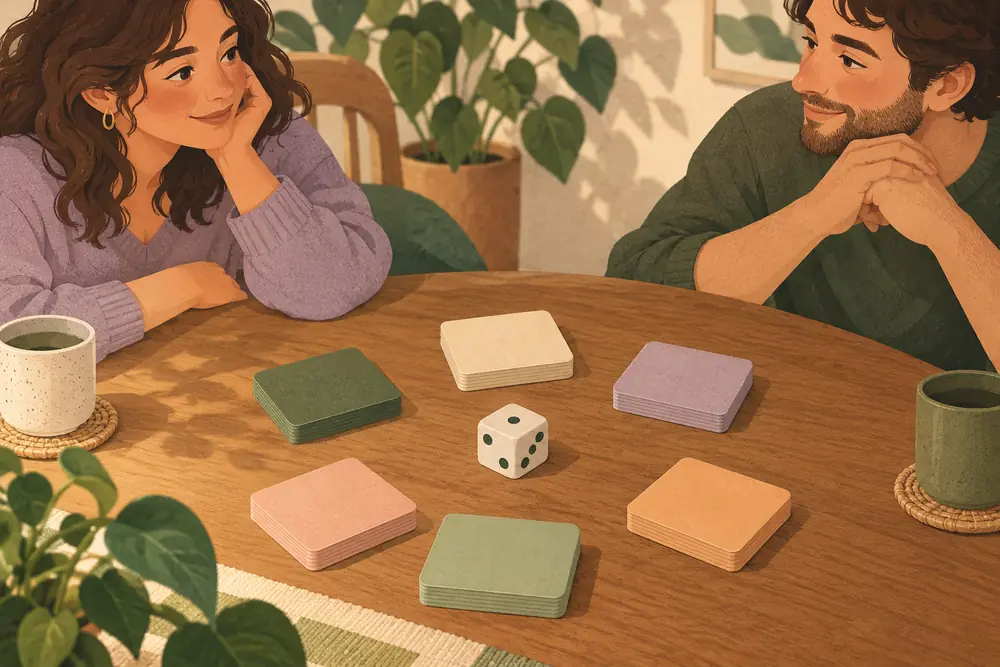
A six-category conversation dice game with 24 original prompts. Use the on-page category roll or an ordinary die, then draw one of that category's four cards. Picking a category yourself works too. There are no points, winners, or stakes.
2–8 adultsOne card or a short shared round24 original prompts6 question groups
An original scene illustration. The playable prompts and instructions are below.
Roll a category. Draw a conversation. Choose one prompt to begin; there is no need to finish the deck.
What small design detail makes an everyday object easier to understand?
Read all questions below or print the complete deck. Enable JavaScript for shuffled rounds and question-group selection.
This page has no answer field and does not collect replies. Other call or chat services have their own privacy settings.
A little structure, plenty of room
How to use these questions.
A six-category conversation dice game with 24 original prompts. Use the on-page category roll or an ordinary die, then draw one of that category's four cards. Picking a category yourself works too. There are no points, winners, or stakes.
Choose a small adult group and explain that each person may answer, invent an answer, listen, or pass. Use the on-page roll, or roll an ordinary die on the table.
Match the result to one of the six numbered groups. Read a card from that group; the online roll draws one card, while manual group selection can draw several.
Invite volunteers and roll again only if the group wants another card. A category roll starts a new draw, so a later roll can revisit an earlier card.
One shared opening · 3–5 minutes
Offer one card, allow thinking time, and invite volunteers. Finish at the agreed point; suggested times have not been tested with groups.
A die-free table · 5–10 minutes
Choose a numbered category together instead of rolling. The same four cards belong to that category online and in both PDFs.
Suggested times are host plans, not results measured with groups. No one needs to finish the deck.
Choose a way to join.
Agree on a format before starting. A quiet pause or an early finish is always available.
A shared invitation
One card, optional replies
Choose a small adult group and explain that each person may answer, invent an answer, listen, or pass. Use the on-page roll, or roll an ordinary die on the table.
Match the result to one of the six numbered groups. Read a card from that group; the online roll draws one card, while manual group selection can draw several.
A die-free table
Adapt or stop at the agreed point
Choose a numbered category together instead of rolling. The same four cards belong to that category online and in both PDFs.
Invite volunteers and roll again only if the group wants another card. A category roll starts a new draw, so a later roll can revisit an earlier card.
A short host checklist.
Explain how the activity ends before it starts.
Keep listening, passing, and quiet thinking available.
Do not collect, rank, photograph, or publish answers.
Choose the questions that fit
24 prompts. Choose a group.
The online player can mix all groups or draw from just one. These are the same prompts you’ll find in both PDFs.
1 / Small observations
4 prompts · Cards F34-001–F34-004
What small design detail makes an everyday object easier to understand?F34-001 · REV 2026-10-18.1
What is an ordinary sound you would put in a collection of tiny observations?F34-002 · REV 2026-10-18.1
What could you learn by looking closely at an imaginary door handle?F34-003 · REV 2026-10-18.1
What would deserve a caption in a photo of an empty breakfast table?F34-004 · REV 2026-10-18.1
2 / Everyday inventions
4 prompts · Cards F34-005–F34-008
Invent a pocket for something that does not usually need a pocket.F34-005 · REV 2026-10-18.1
What would a self-tidying bookmark do when nobody was reading?F34-006 · REV 2026-10-18.1
Design a useful attachment for an ordinary paper clip.F34-007 · REV 2026-10-18.1
What would a lamp made for reading maps of imaginary places look like?F34-008 · REV 2026-10-18.1
3 / Places to imagine
4 prompts · Cards F34-009–F34-012
What would be in a garden designed for visitors the size of a teaspoon?F34-009 · REV 2026-10-18.1
What would a waiting room inside a lighthouse look like?F34-010 · REV 2026-10-18.1
What would you put in a tiny museum at the end of a footbridge?F34-011 · REV 2026-10-18.1
Describe a shop where the shelves hold different kinds of quiet.F34-012 · REV 2026-10-18.1
4 / Tiny stories
4 prompts · Cards F34-013–F34-016
Tell a two-sentence story about a parcel addressed to a bench.F34-013 · REV 2026-10-18.1
What happens when a shopping list turns into a treasure map for ordinary objects?F34-014 · REV 2026-10-18.1
Invent a short conversation between a window and a passing paper airplane.F34-015 · REV 2026-10-18.1
What could happen when a postcard arrives before the place on it exists?F34-016 · REV 2026-10-18.1
5 / Gentle opinions
4 prompts · Cards F34-017–F34-020
What everyday object deserves a more descriptive name?F34-017 · REV 2026-10-18.1
What makes a small handwritten sign easy to understand?F34-018 · REV 2026-10-18.1
What would improve a queue made entirely of imaginary creatures?F34-019 · REV 2026-10-18.1
What is a good reason to leave a little empty space in a design?F34-020 · REV 2026-10-18.1
6 / Curious combinations
4 prompts · Cards F34-021–F34-024
What could you invent by combining a bookmark with a doorbell?F34-021 · REV 2026-10-18.1
What would a garden and a stationery shop make together?F34-022 · REV 2026-10-18.1
What could a cloud borrow from a kitchen drawer?F34-023 · REV 2026-10-18.1
What would happen if a map and a recipe exchanged their jobs?F34-024 · REV 2026-10-18.1
A few things before you start.
Can a later roll repeat a card?
Yes. Each category roll starts a new one-card draw, so a later roll can revisit a card. A normal multi-card round within one selected group has no repeats.
Do Letter and A4 contain the same prompts?
Yes. Both sizes include all 24 cards and the same host notes, with layouts sized for their own paper. Download the matching file, print single-sided at 100% / Actual size, and test a page before the full set.
Do we have to finish the whole deck?
No. Use one card, a chosen group, or a short round. Stop at the agreed point or whenever people would rather move on. Passing needs no explanation.
Original AI-assisted questions with an AI English editorial pass. Independent human language review and group playtesting remain pending. Editorial notes.