Try 24 short conversation cards before a tabletop game, between rounds, or while deciding what to play next. The final group invites you to invent a tiny game together. No knowledge of a particular game is required.
2–8 adultsOne card or a short shared round24 original prompts3 question groups
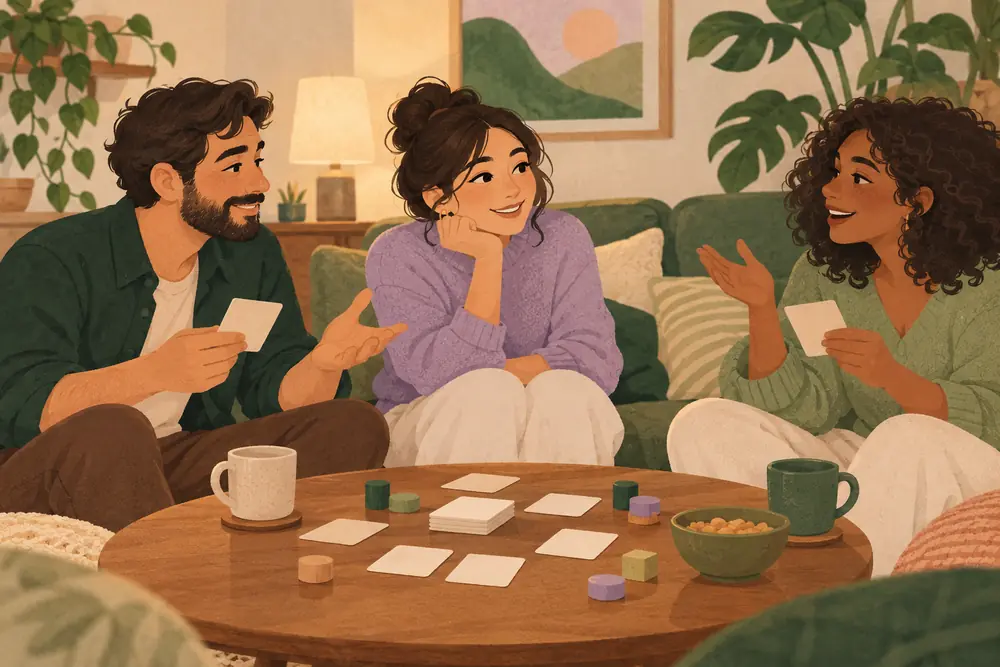
An original scene illustration. The playable prompts and instructions are below.
A small warm-up before the first move. Choose one prompt to begin; there is no need to finish the deck.
What makes a game explanation easy to follow the first time?
Read all questions below or print the complete deck. Enable JavaScript for shuffled rounds and question-group selection.
This page has no answer field and does not collect replies. Other call or chat services have their own privacy settings.
A little structure, plenty of room
How to use these questions.
Try 24 short conversation cards before a tabletop game, between rounds, or while deciding what to play next. The final group invites you to invent a tiny game together. No knowledge of a particular game is required.
Offer a short warm-up before explaining the actual game. Choose Before the first game, Between rounds, or Invent a game.
Read one card and invite volunteers. Someone who would rather watch or learn the main game can listen or pass.
End before the warm-up becomes another obligation. Put these cards aside when the game explanation or next round begins.
One shared opening · 3–5 minutes
Offer one card, allow thinking time, and invite volunteers. Finish at the agreed point; suggested times have not been tested with groups.
Between two games · 5–10 minutes
Pick one card during a planned pause. Avoid interrupting a turn, ranking players, or turning answers into a score.
Suggested times are host plans, not results measured with groups. No one needs to finish the deck.
Choose a way to join.
Agree on a format before starting. A quiet pause or an early finish is always available.
A shared invitation
One card, optional replies
Offer a short warm-up before explaining the actual game. Choose Before the first game, Between rounds, or Invent a game.
Read one card and invite volunteers. Someone who would rather watch or learn the main game can listen or pass.
Between two games
Adapt or stop at the agreed point
Pick one card during a planned pause. Avoid interrupting a turn, ranking players, or turning answers into a score.
End before the warm-up becomes another obligation. Put these cards aside when the game explanation or next round begins.
A short host checklist.
Explain how the activity ends before it starts.
Keep listening, passing, and quiet thinking available.
Do not collect, rank, photograph, or publish answers.
Choose the questions that fit
24 prompts. Choose a group.
The online player can mix all groups or draw from just one. These are the same prompts you’ll find in both PDFs.
Before the first game
8 prompts · Cards F24-001–F24-008
What makes a game explanation easy to follow the first time?F24-001 · REV 2026-10-18.1
What would you put on a welcome card for someone joining game night for the first time?F24-002 · REV 2026-10-18.1
What is a friendly way to ask for a practice turn?F24-003 · REV 2026-10-18.1
What small detail makes a shared game table easier to use?F24-004 · REV 2026-10-18.1
What would you name a team that changes its name after every game?F24-005 · REV 2026-10-18.1
What should a host say before trying a game nobody knows yet?F24-006 · REV 2026-10-18.1
What would make watching a round feel like a welcome way to join in?F24-007 · REV 2026-10-18.1
What is a good reason to choose a short game for the first round?F24-008 · REV 2026-10-18.1
Between rounds
8 prompts · Cards F24-009–F24-016
What would you title a recap of a round where nothing went as expected?F24-009 · REV 2026-10-18.1
What could a group do during a break that needs no extra equipment?F24-010 · REV 2026-10-18.1
What is an amusing reason for a fictional game piece to leave the board?F24-011 · REV 2026-10-18.1
What would make a good announcement between two very different games?F24-012 · REV 2026-10-18.1
What would a lost counter write on a tiny missing-person poster about itself?F24-013 · REV 2026-10-18.1
What would you ask a rulebook if it could answer one question?F24-014 · REV 2026-10-18.1
What harmless house rule would be funny for one practice round only?F24-015 · REV 2026-10-18.1
What is a satisfying way to finish game night while people still want to come back?F24-016 · REV 2026-10-18.1
Invent a game
8 prompts · Cards F24-017–F24-024
Design a game where everyone is trying to finish the same tiny garden.F24-017 · REV 2026-10-18.1
What would be the goal of a board game about borrowing umbrellas?F24-018 · REV 2026-10-18.1
Invent a game piece with a useful job besides moving forward.F24-019 · REV 2026-10-18.1
What could a cooperative game ask players to build without stacking anything?F24-020 · REV 2026-10-18.1
Invent a turn that helps another player without deciding their next move.F24-021 · REV 2026-10-18.1
What would a game about delivering letters to clouds need on its board?F24-022 · REV 2026-10-18.1
How could a game end with several different good outcomes?F24-023 · REV 2026-10-18.1
Invent a one-sentence rule for a game played with imaginary buttons.F24-024 · REV 2026-10-18.1
A few things before you start.
Does everyone need to know the same board games?
No. These cards use general tabletop ideas and invented games. There is no trivia, branded game content, drinking rule, or requirement to explain a game you know.
Do Letter and A4 contain the same prompts?
Yes. Both sizes include all 24 cards and the same host notes, with layouts sized for their own paper. Download the matching file, print single-sided at 100% / Actual size, and test a page before the full set.
Do we have to finish the whole deck?
No. Use one card, a chosen group, or a short round. Stop at the agreed point or whenever people would rather move on. Passing needs no explanation.
Original AI-assisted questions with an AI English editorial pass. Independent human language review and group playtesting remain pending. Editorial notes.