Home / Question games / Project Kickoff Icebreakers and Conversation Cards
Free adult activities / Always okay to pass
Project Kickoff Icebreakers and Conversation Cards.
Use 24 project kickoff prompts to open a small adult meeting. Start lightly, explore how a sample plan could be clearer, or imagine a fictional project. Use general examples; these cards do not replace project decisions or ask for confidential work.
2–8 adultsOne card or a short shared round24 original prompts3 question groups
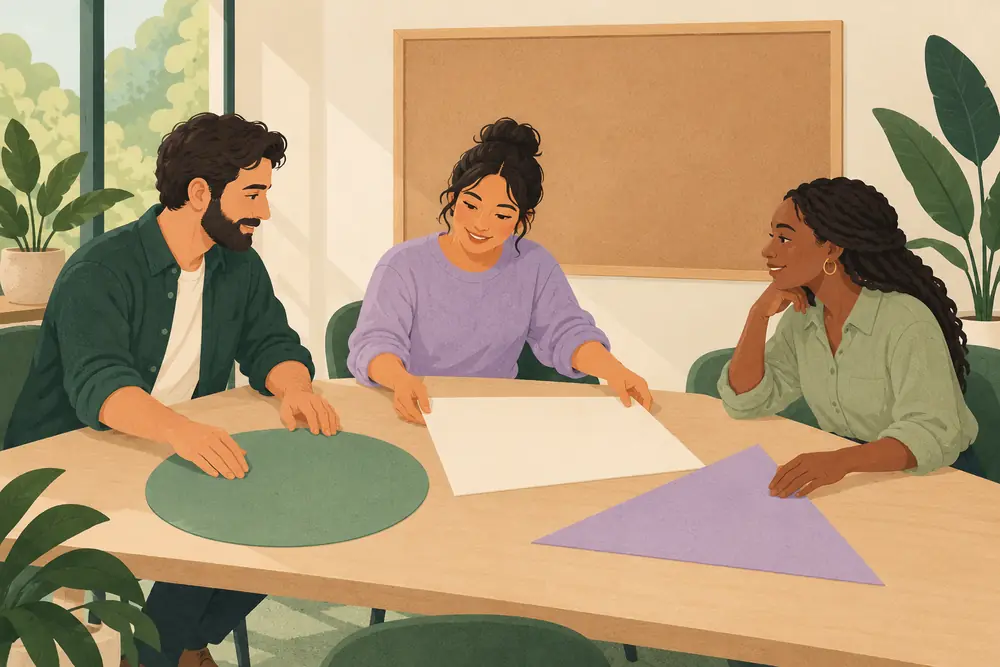
An original scene illustration. The playable prompts and instructions are below.
One shared question before the real project agenda. Choose one prompt to begin; there is no need to finish the deck.
What makes the start of a project feel clearly different from an ordinary update?
Read all questions below or print the complete deck. Enable JavaScript for shuffled rounds and question-group selection.
This page has no answer field and does not collect replies. Other call or chat services have their own privacy settings.
A little structure, plenty of room
How to use these questions.
Use 24 project kickoff prompts to open a small adult meeting. Start lightly, explore how a sample plan could be clearer, or imagine a fictional project. Use general examples; these cards do not replace project decisions or ask for confidential work.
Explain that the opening is optional and separate from the project agenda. Choose one card and use a fictional example if that keeps the discussion simpler.
Invite brief voluntary replies. Do not assess skills, ask people to defend their work preferences, or open private project files.
Close the activity explicitly. If an actual project suggestion arises, ask separately whether it belongs in the official agenda or notes.
One shared opening · 3–5 minutes
Offer one card, allow thinking time, and invite volunteers. Finish at the agreed point; suggested times have not been tested with groups.
A practical opening · 5–10 minutes
Choose one Make the plan clearer card and discuss an invented example. Move to actual project decisions only after closing the activity.
Suggested times are host plans, not results measured with groups. No one needs to finish the deck.
Choose a way to join.
Agree on a format before starting. A quiet pause or an early finish is always available.
A shared invitation
One card, optional replies
Explain that the opening is optional and separate from the project agenda. Choose one card and use a fictional example if that keeps the discussion simpler.
Invite brief voluntary replies. Do not assess skills, ask people to defend their work preferences, or open private project files.
A practical opening
Adapt or stop at the agreed point
Choose one Make the plan clearer card and discuss an invented example. Move to actual project decisions only after closing the activity.
Close the activity explicitly. If an actual project suggestion arises, ask separately whether it belongs in the official agenda or notes.
A short host checklist.
Explain how the activity ends before it starts.
Keep listening, passing, and quiet thinking available.
Do not collect, rank, photograph, or publish answers.
Choose the questions that fit
24 prompts. Choose a group.
The online player can mix all groups or draw from just one. These are the same prompts you’ll find in both PDFs.
Before we begin
8 prompts · Cards F28-001–F28-008
What makes the start of a project feel clearly different from an ordinary update?F28-001 · REV 2026-10-18.1
What would you want a fictional project's one-sentence introduction to explain?F28-002 · REV 2026-10-18.1
What is a useful question to ask before agreeing on what a project is trying to make?F28-003 · REV 2026-10-18.1
What could a kickoff invitation say so people know what preparation is optional?F28-004 · REV 2026-10-18.1
What everyday object would make a good prop for explaining the difference between an idea and a plan?F28-005 · REV 2026-10-18.1
What would you put in a box labeled 'Questions for later' at a kickoff?F28-006 · REV 2026-10-18.1
What could make a first project conversation easier for someone joining by audio only?F28-007 · REV 2026-10-18.1
What would be a clear closing sentence before the kickoff moves to its real agenda?F28-008 · REV 2026-10-18.1
Make the plan clearer
8 prompts · Cards F28-009–F28-016
How could a sample plan show which parts are still assumptions?F28-009 · REV 2026-10-18.1
What should a fictional project brief explain about the people who will use the result?F28-010 · REV 2026-10-18.1
What could a group ask when the word 'simple' means different things to different people?F28-011 · REV 2026-10-18.1
What would distinguish a useful example from a final specification in a made-up plan?F28-012 · REV 2026-10-18.1
What could a project map show besides a list of tasks?F28-013 · REV 2026-10-18.1
How could a team make a change of direction visible without erasing the earlier idea?F28-014 · REV 2026-10-18.1
What would you include in a sample handover note for a project made entirely from paper?F28-015 · REV 2026-10-18.1
What question could reveal that two people are imagining different finished objects?F28-016 · REV 2026-10-18.1
A fictional project
8 prompts · Cards F28-017–F28-024
What would be the first decision when designing a pocket-sized public garden?F28-017 · REV 2026-10-18.1
What would count as finished for a project building a map of imaginary doorways?F28-018 · REV 2026-10-18.1
What would you leave out of a clock designed for a town that prefers approximate times?F28-019 · REV 2026-10-18.1
What would you prototype first for a library that lends shadows?F28-020 · REV 2026-10-18.1
What would a project brief for a foldaway picnic island need to explain?F28-021 · REV 2026-10-18.1
What would be a useful test for a signpost that points toward interesting questions?F28-022 · REV 2026-10-18.1
What could go in the first sketch of a museum display about invisible inventions?F28-023 · REV 2026-10-18.1
What would the handover instructions say for a machine that sorts daydreams by shape?F28-024 · REV 2026-10-18.1
A few things before you start.
Should these answers become project requirements?
No. Treat the cards as a casual opening. Check any useful suggestion separately during the real project discussion before recording it as a decision or requirement.
Do Letter and A4 contain the same prompts?
Yes. Both sizes include all 24 cards and the same host notes, with layouts sized for their own paper. Download the matching file, print single-sided at 100% / Actual size, and test a page before the full set.
Do we have to finish the whole deck?
No. Use one card, a chosen group, or a short round. Stop at the agreed point or whenever people would rather move on. Passing needs no explanation.
Original AI-assisted questions with an AI English editorial pass. Independent human language review and group playtesting remain pending. Editorial notes.